Friday, October 2, 2009

Cosmic Friday: Message from Machaut

I was tempted to do a image of mars for this weeks Cosmic Friday, but then, just today, some images of NASA's MESSENGER spacecraft were released from its third flyby of mercury, and there was an awesome (in the filled with awe sense) image of Machaut Crater that made me re-evaluate my decision and give this weeks honors to that oft forgotten messenger to the gods, and the closest and mysterious planet of Mercury. 


I'm very intregued to find out why the crater has these beautiful criss-crossing patters throughtout the lava flows. also I would love to see a more detailed image of the smaller shadowed crater in the center of Machaut. 

Wednesday, September 30, 2009

Hard Problems at MSRI

I am here at the Mathematical Sciences Research Institute for the northern California premier of Hard Problems, a documentary about the Math Olympiad.

Quotes from the movie I thought were particularly good

  1.  The subject of math rather than just the random facts I was taught in school
  2.  Math is more of exploration than knowledge
  3.  You cant really do math emotionally, that doesn't make sense.
  4.  Math doesn't have to be straight out of the book,
  5. For a really cool problem you can explain how its really cool without having to get in the gritty details, I think math is like that it speaks for itself its very beautiful.
  6. I have a little bit of a distaste for schools.
  7. I have this theory that the smarter a mathematician is the better a mathematician is, the less they like to work.... I don't know if its true, I haven't asked enough mathematicians
  8. I don't do mathematics because its mathematics. I do it because of the astounding connections and creativity it allows (ending line, one I think that is very incisive about the nature of mathematics
And now, onto the Q&A panel.
7:05  Two interesting threads, the moderator brings up, the one about what the IMO is and questions about the IMO and then also about how to bring more people into the IMO and increase higher mathematics training, however, the question i find interesting, and want to hear about, is instead how we can take the lessons gained from the higher level math education to get better math education around the board not just for those kids gifted with math talent, but to increase math education overall.

7:15 Zvezdelina Sankova puts on an interesting presentation about the Berkeley math circle, it seems like a great way to teach math, why don't we adapt a math circle setup to teach math to all children?

7: 20 Melanie makes a great point on how most of the students who do the IMO have seen some exciting math whereas moth high school students have not seen any interesting math.

7:25 Competition aspect is an important hook. "competitions were the venue in which I learned that there was interesting math"

7:40 Guy behind me comments on how the math circles helped him teach and make better, Zvezdelina makes a point about how the BMC was supposed to me a trail program, and that the allocation of resources is making it happen at colleges and universities, not schools.


7:50 some douchebag in the back asks 4 annoying questions, I hope he dies in a fire.

7:50 Ryan makes a good point about how people are not exposed to interesting math problems.

7:55 I get a question in on the first quote in the list, Zevezdelina talks about how the math circle gives the problem first then develops the tools to solve it rather than just give students the tools of mathematics with no context rhyme or reason.

ill distill this into some final thoughts when I get home.

Tuesday, September 29, 2009

Mars City Planning Commision, Beginning of a Series

Well I have recently been thinking a lot about what it would take to colonize mars. (Yes yes, I know, it’s not very surprising that my thoughts have gone this way is it, oh mythical regular reader?)


So, to this end, I am announcing a new recurring feature for this blog 'Mars City Planning Commission" where I will attempt to list the problems and possible solutions for setting up a colony on mars. To this end, if you have any ideas, any problems, any comments, I certainly could use them. Every bit of information helps. Hopefully, I can get my ass in gear enough to make this a weekly posting, either on Mondays or Tuesdays.


So step 1, brainstorming a whole load of problems.

  1. Air
  2. Water
  3. Heat
  4. Food
  5. Shelter
  6. Transportation to Mars
  7. Landing on Mars
  8. Solar Radiation
  9. Where to Land
  10. Dust storms and other Martian Weather
  11. Illness of Colonists
  12. Sanity of Colonists
  13. Building Materials (Thanks to Orodromeus for bringing this one up)


Also it looks like I am forced to re-read Kim Stanley Robinson's Mars Trilogy again...


Anyway, I'm going to continue looking at this list and next week, ill have a longer and more exhaustive list of problems with a little run down of exactly what the problem is.


And Tomorrow, if all goes as planned, I will be Bogging (perhaps, live, I mean, I will have my laptop with me) on the Premiere of Hard Problems at the Mathematical Sciences Research Institute

Friday, September 25, 2009

Cosmic Friday: Saturnal Equinox

I had a bit of trouble deciding on which image to use for this weeks Cosmic Friday, I saw many beautiful pictures of nebula's and galaxies, but, well, we have had a bunch  images in those scales recently, and bodies of  the smaller solar scale have been missing from our sojourns into the greater cosmos, and then I saw a beautiful image of Saturn at Equinox, and well, I think it speaks for itself.


Thursday, September 24, 2009

Water Water Everywhere

My desire for extra-planetary emigration is well documented, so, when I saw two interesting articles about water on both Luna and Mars, I had to talk about them and their effect on bringing about the belated retrofuture.

Before I talk about the moon, I want to mention a finding that has been overshadowed by the moon finding (which, admittedly, is very very exciting.) However, Here on Between Worlds I'm going to give Mars the first billing. a few meteorites that smashed into mars last year have uncovered martian ice at latitudes much closer to the equator than we have expected to find ice. This means that ice is much more plentiful on mars than we previously thought.

What I find most fascinating about this is a coincidence that only proves that nature has a twisted sense of humor. One of the meteorites revealed ice no more than 4 inches from where the 1970's Viking 2 lander dug a trench into mars. If the viking lander had dug its trench only 3.5 inches deeper, it would have likely revealed the ice, and certainly would have changed how we view mars and martian exploration in the past 4 decades.

But onto the big story of the day, The Indian Chandrayaan-1 mission, using NASA's Moon Meteorology Mapper, has discovered that the moon is damp. Water, while not abundant, is definitively present on the moon. One of the major problems that has been facing a Lunar Colony has been the assumed dryness of the lunar surface. If we were unable to find water on the moon, we would have to ship it all up from earth, and that puts a major major crimp in any plans. the energy cost of shipping it all up is extensive to say the least (if you don't believe me, ask anyone who has gone to burning man)
 Furthermore, we gain more than just drinking water when we find water on the planetary bodies and moons we wish to colonize, Rocket-fuel and Breathable Oxygen all can be made once we have that good ol' Hydrogen Hydroxide (don't listen to the fools who call it 'dihydrogen monoxide' they don't know what they are talking about).

These findings force us to radically change our previous conceptions about the rarity of water in the solar system. The increased water we find throughout the system can and will be used to sustain human colonies on other planets.  Overpopulation has become a major problem for humanity, we can fix this in two ways, decreasing population, and increasing resources/area. However, our home planet is fast becoming tapped out of resources, so, where do we go? To the stars, where else? This is one of the major callings of our generation. We must break free from the gravity well that keeps us on this planet. The water findings just give us the confidence that allows us to take bold action in taking the next step to become the first species (so far as we know) to spread itself out to the stars.

Tuesday, September 22, 2009

Mathematics of Steallar Death

Applied Mathematicians and Astrophysicists at Lawrence Berkeley National Laboratory have recently created a simulation of the last few hours of a white dwarf star leading up to a type 1a supernova. regular readers (ha, check it out, I made a funny) may remember me blogging about type 1a supernova earlier in the month. So I felt some obligation to post this awesome new finding about them.

For years type 1a supernova have been a standard candle for astrophysicists because it is theorized that they all blow up the same way, however, we have until now, a good computational simulation of the creation of type 1a supernovas has seemed intractable, which begged the question, "do they really all blow up the same way? if we cant simulate it, perhaps they don't..."

But, Mathematics once again came to the rescue as applied mathematicians Ann Almgren, John Bell and Andy Nonaka of Berkeley Lab's Computational Research Division,  developed MAESTRO, a simulation code of the problem. The real genius behind MAESTRO was to strip out the sound waves making the problem much more efficient and able to run on modern day supercomputers like the Jaguar, the Cray XT4, one of the worlds most powerful supercomputers.

read the full article Here at Science Daily.

Monday, September 21, 2009

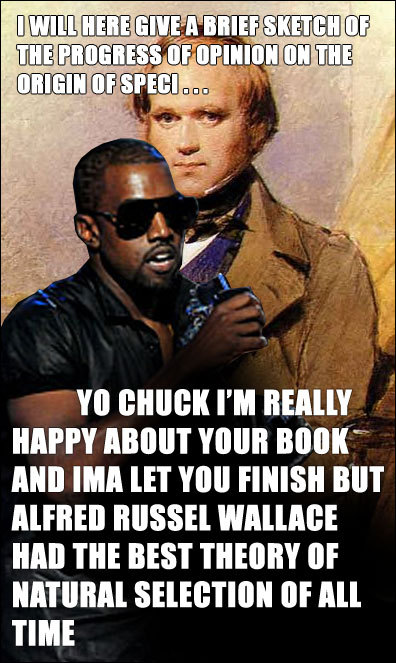
Kanye Meme

Found this on the interwebs, pretty brilliant


I sort of want to see one with kanye and PZ on the dino with Kanye Saying "YO PZ, IMMA LET YOU FINISH RIDING THE DINO, BUT BERTRAND RUSSELL IS THE GREATEST ATHEIST OF ALL TIME!!!!


Edit: so i figured, what the hell, I can make it, and while doing so I got I think, a slightly better idea